Polymer physics · 2016
Nematic ordering in supramolecular systems
How molecular pairing and collective alignment influence one another.
Institute of Macromolecular Compounds, Russian Academy of Sciences, St. Petersburg
About this research
In some mixtures, molecules can temporarily join into pairs that behave differently from the separate components. These pairs may favour a common orientation, producing nematic liquid-crystal order. Pair formation and alignment are connected: changing one can change the conditions for the other.
This theoretical study examines that connection in two settings: a mixture of small molecules, and a polymer mixed with a small-molecule dopant. It brings reversible binding and orientational order into one thermodynamic description to explore how temperature and composition affect the possible phases. Comparing the two settings shows why attaching one component to a polymer changes the balance between mixing, binding, and ordering.
Read on the publisher’s site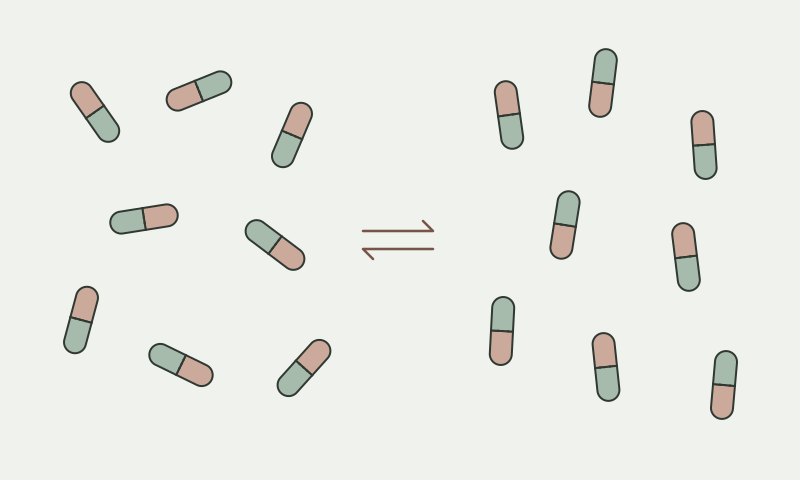
Publication
T. M. Birshtein, V. M. Amoskov, and E. O. Smirnov. Theory of Nematic Ordering in Supramolecular Systems: Self-Assembly of Mesogenic Groups and Self-Organization of the System. Polymer Science, Series A 58, 593–605 (2016). DOI: 10.1134/S0965545X16040040.
DOI: 10.1134/S0965545X16040040Publication records & citations
Publication records
- Springer Nature
Publisher record for the 2016 English article, listing T. M. Birshtein, V. M. Amoskov, and E. O. Smirnov, with the journal, pages, and DOI.
- SPbU Researchers Portal
St Petersburg University's research record lists all three authors and identifies the 2016 publication as a peer-reviewed journal article.
Citing research
- Molecular Mobility in Oriented and Unoriented Membranes Based on Poly[2-(Aziridin-1-yl)ethanol]
R. Teruel-Juanes et al. Polymers 13(7), 1060 (2021).
Cites this paper as reference 1. The reference list is available in the PubMed record.
DOI: 10.3390/polym13071060