esmirnov.ai
Exact error thresholds and relaxed-host measurements for elastic mode discrimination
When can changing the supports of a material distinguish two competing elastic models? This work compares a two-rail support assembly with a one-rail surrogate after an associating host has relaxed. The two models can match the released and clamped calibration measurements while responding differently at intermediate support settings.
The analysis derives a joint-feasibility test for positive one-mode responses with bounded sample errors. A worked spring design gives an exact ideal separation threshold. Separate finite-force observation bounds account for sensor errors, support tolerances, preparation, and finite settling times for both physical hypotheses.
The manuscript is in preparation, with human scientific review pending. Its examples follow from specified equations and deterministic calculations; they are not laboratory measurements.
- Soft matter theory
- Elasticity
- Model discrimination
- Bounded-error inference
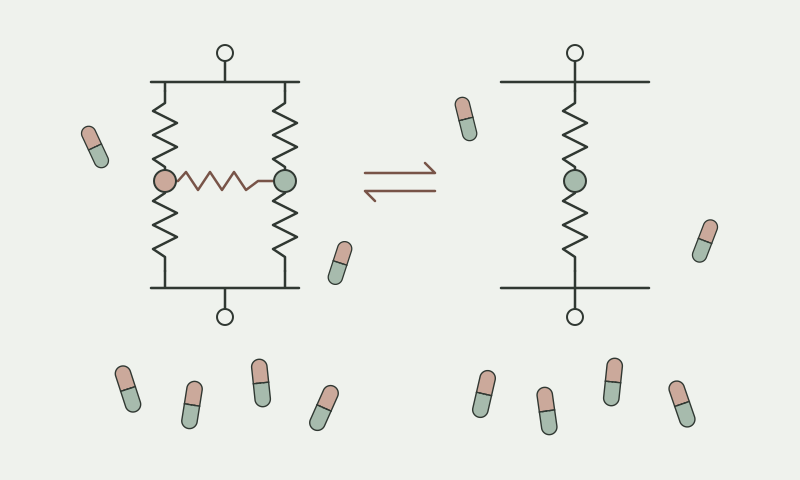 Elastic modes in a relaxing host · original concept illustration